

Among the Stars
Exploring the bear archetype through myth and time
For April’s theme of “Awakening,” as bears awaken from hibernation, I’d like to introduce you to the namesake of this Substack, plus some other bear myths woven through the mists of time.
There once was a nymph who was seduced by a god. She soon carried his child, but when his wife—a goddess—discovered the affair, she transformed the nymph into a bear. Cursed to forever be parted from her child, her son was raised in a village while she prowled the woods alone. The boy grew into a strong young man, unaware of his mother’s presence in the forest nearby.
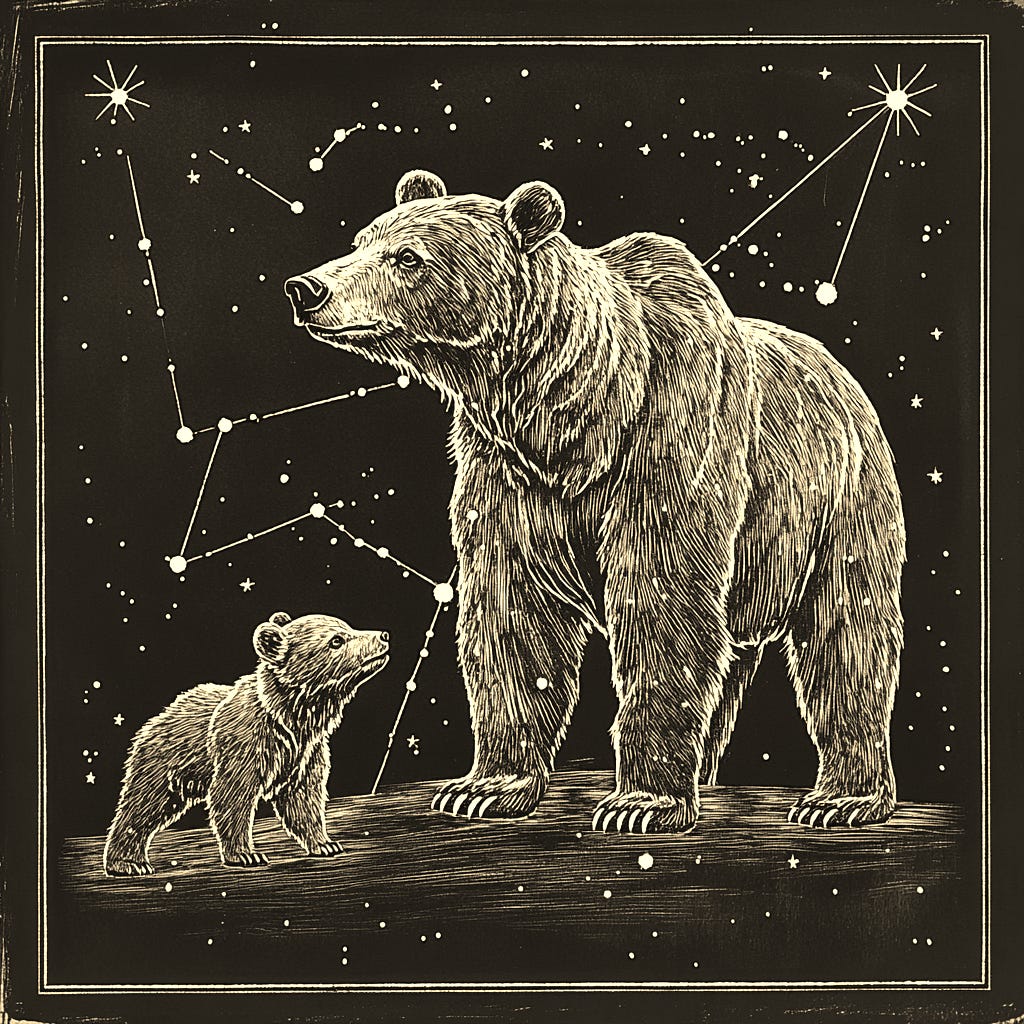
One day, he joined a hunting party, searching for bears. They followed his mother’s tracks into the woods, eventually cornering her without an escape. Oblivious to her curse, the nymph’s son raised his spear, poised to kill his mother—when fate intervened. His father used his divine power to lift the nymph and her son into the sky, turning them into stars. There they remain to this day: a mother and her cub, as the constellations we know as Ursa Major and Ursa Minor.
This story is told in various versions from Greek mythology, often with Zeus as the father and either Hera or Artemis transforming the nymph into her bear form. While the story reinforces stereotypes of marital jealousy and spite, I love looking up at the night sky, imagining the she-bear with her cub.
The nymph’s curse symbolizes a severance of maternal connection—her wisdom lost to wander alone in the woods, or be attacked by the masculine worldview. It’s a pain we have felt across time and cultures, yet we simply need to step into the forest to find her again. She’s patiently waiting for us, blazing bright among the trees.
Artio: The She-Bear
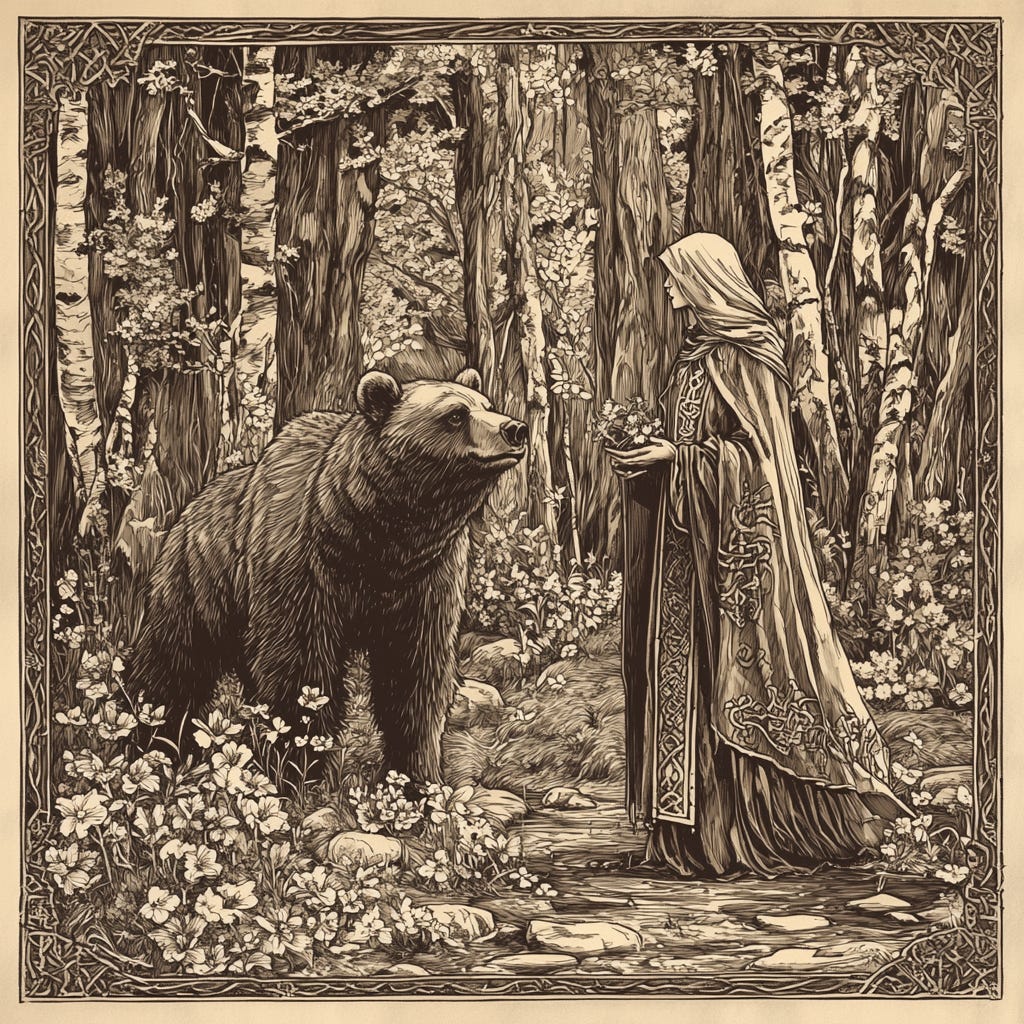
Her wisdom is still alive within Celtic tribes—specifically the Helvettii confederation. They worship Artio, the she-bear of protection and strength (and my inspiration for this journal). Her name comes from the Celtic artos, meaning “bear” and she’s connected to fierce maternal instincts and transformation. But she isn’t just rooted in mythology—Artio is connected to the very land where bears once roamed.
Thousands of years ago, Celtic lands were covered in a woodland ecosystem where bears thrived. The tribes were animists, a core belief in all living things possessing a spirit or soul. These close ties to the land built a symbiotic relationship with the world around them, but that began to change as the Romans invaded Britannia.
If you’re unfamiliar, Rome set up shop in what is now Britain in 43 AD, extorting the land and people for resources like timber and precious metals. If you want to see an interesting (yet very fictional) take on this- the show Britannia is worth a watch. The Romans demanded loyalty from the local tribes, often through diplomacy and taxes. Of course with their infamous armies, they would also resort to military force to ensure compliance (sound familiar? Native Americans might agree).
By 60 AD, many of the tribes were ready to rebel against these invaders, and the Celtic queen, Boudica, rallied 100,000 warriors to take back their lands (if you’re interested, Melanie Karsak's series really brings this period in history to life). She had many victories, including seizing Londinium (present day London). But ultimately Boudica failed, leading to the Romanization of the region. Just as native bears were hunted as their habitat was destroyed, the ways of the Celts began to fade.
Saint Ursula
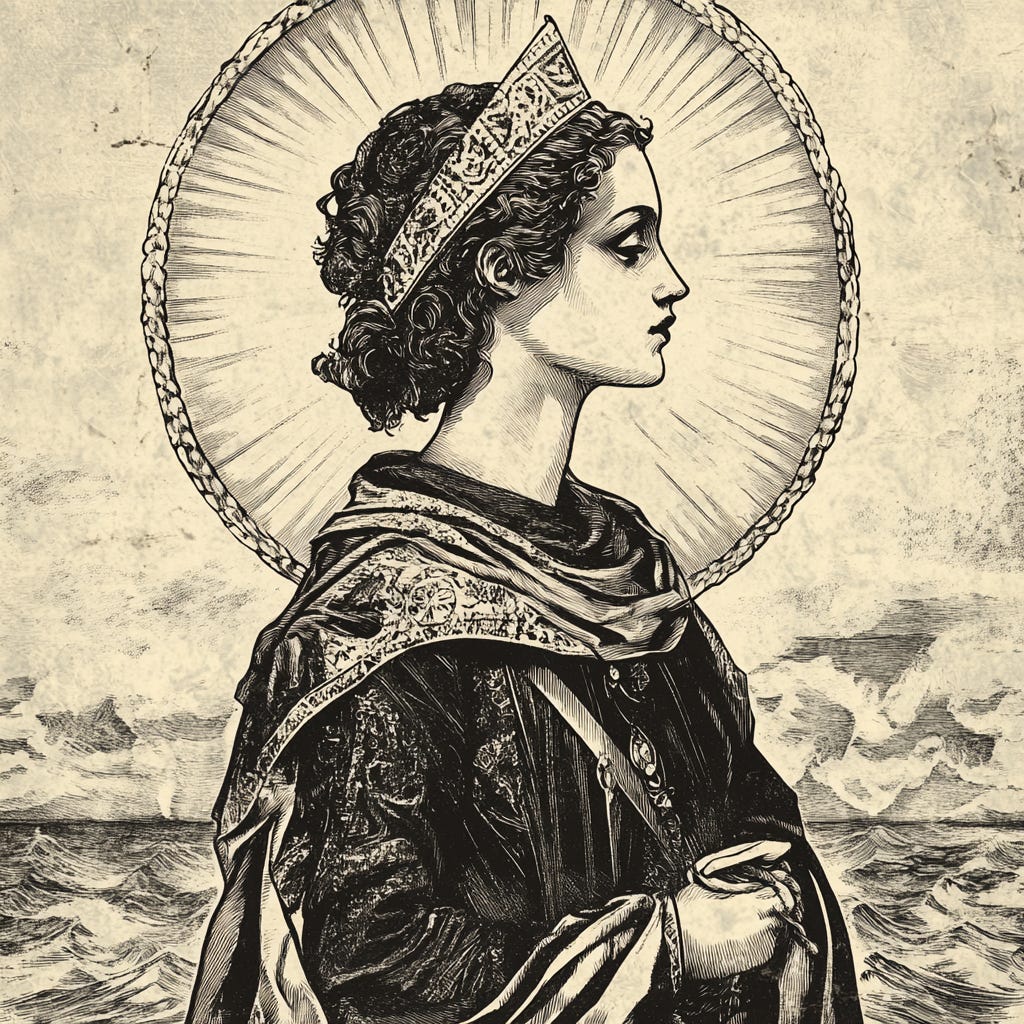
Four hundred years later, a Christian princess sets sail to meet her future husband, a pagan king. Her ship is caught in a terrible storm, taking her off course. Instead of continuing on to her betrothed, the princess decides to reaffirm her faith by making a pilgrimage to Rome. Along the way, she’s captured by the Huns and asked to marry their leader. Bound by her vow of chastity, she refuses. In response, she and her entourage are all beheaded. But with this brave act, she ascends to heaven as a saint.
Thus the princess becomes a martyr, Saint Ursula, a legend from the 4th or 5th century. By this time, Rome had been driven out of Britain, but Christianity was on the rise. This new faith spread as missionaries began to convert people from their heathen pagan ways (both Celtic and Roman), to align with the one true god. Saint Ursula encapsulates this period perfectly, as her betrothed was pagan, yet she keeps her Christian faith until her untimely end.
While Saint Ursula's story is firmly rooted in Christianity, her name means 'little she-bear' in Latin—reminding us of the enduring symbols of the ancient world. Like Artio, both saint and goddess represent protection and transformation, be it through a pilgrimage or emerging from the depths of winter. It’s likely goddesses like Artio were incorporated into Ursula’s symbolism, helping bridge the old pagan ways with the new faith. Oh and does her name sound familiar? Ursula is derived from Ursel, which translates to Ursa—as in Ursa Major and Minor, our bear constellations.
Arthur & Artaois
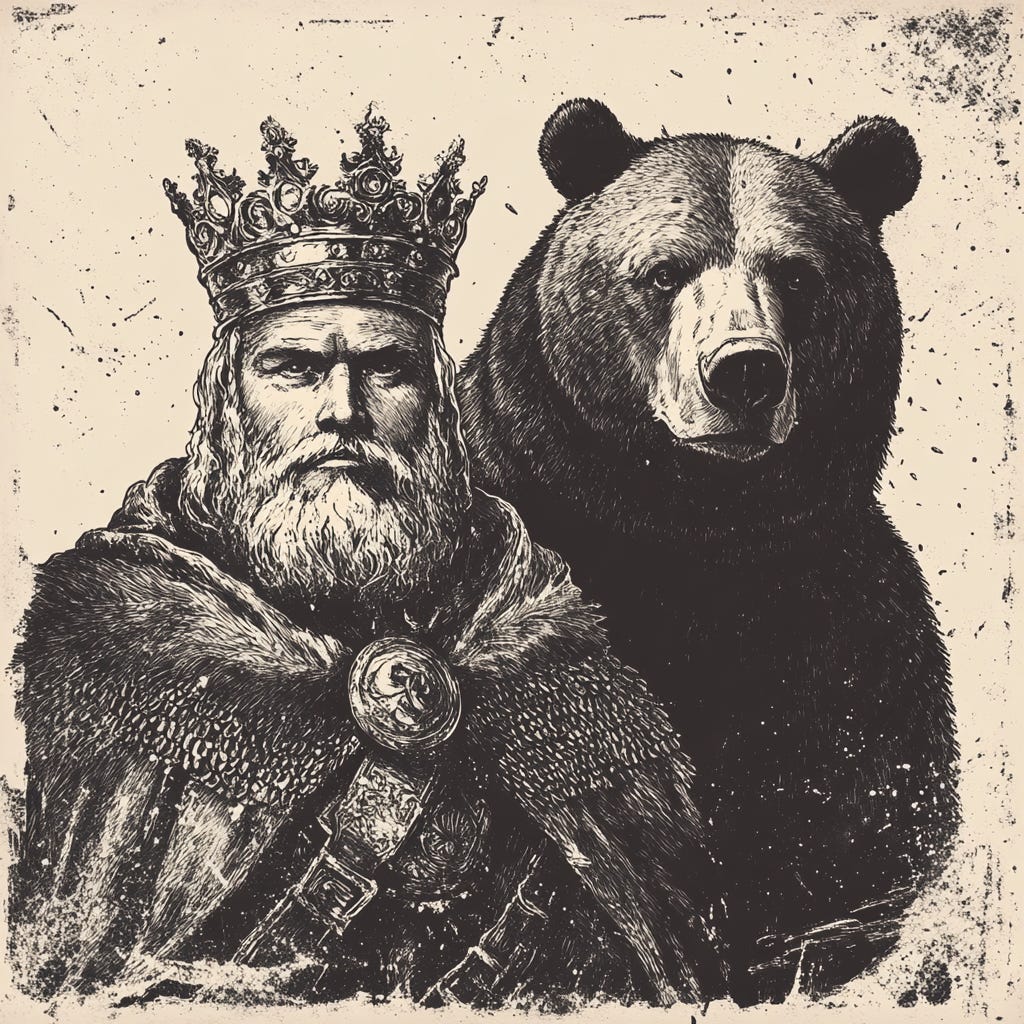
Saint Ursula made her pilgrimage across Europe when native bears were already scarce—but just a hundred years later, their symbolism remained strong. The fabled King Arthur has been connected to the bear god, Artaois, as the linguistics translate from Arthur to the same Celtic artos. Just as the bear god embodies strength and leadership, King Arthur’s role as a protector of his people parallels this ancient symbol.
Though I will not pretend to be an expert on Arthurian legends, the tales often highlight how the last vestiges of Celtic spirituality were overtaken by the Middle Ages. The original stories, found as early as the 6th century, are infused with Celtic pagan elements—full of magic and mysteries of the land. But by the 12th century, the legends evolved to highlight the goodness of Christianity. Merlin, connected to the druids, was reimagined to align with Christian theology. Morgan le Fay, often portrayed as the ruler of Avalon, becomes an antagonist and seductress.
Luckily, there are other perspectives too. The author Marion Zimmer Bradley weaves a Celtic interpretation in her book, “The Mists of Avalon,” depicting Arthur as the last king chosen in the old ways. She highlights how priestesses helped lead the tribes as stewards of their land. Men were their partners, trained as druids to uphold the same traditions. But as Arthur continues to be taken in by his Christian brotherhood, like his native bears, their ancient ways begin to fade into the mist.
Her Sisters
As King Arthur’s knights were gallivanting across the country in search of that pesky Holy Grail, the myths of their world died out with the bears of Britain. Their lands were gone, forests turned to timber as the Celts embraced the newly established faith. They would bend to Christian reign for the next thousand years, with only a whisper of the old ways kept burning.
Yet all of these stories—Greek, Celtic, and Christian—speak to the strength of the she-bear. She has endured throughout the ages for her people, regardless of their faith. Though it might be easy to discard the beliefs of the ancient world, her lessons are all the more relevant today as they were in the time of Rome. And we must remember them—though faded from her Celtic lands, history is repeating itself with the bears of North America. We can still protect her sisters from falling victim to the same deforestation and greed.
Regardless of where we live, we all gaze up at the same night sky as we share stories—of Artio’s strength, Boudica’s fierceness, and Ursula’s bravery. We can clasp hands with our brothers through Artaois, embodying this ancient wisdom that still flows through our veins. And no matter how the she-bear appears to us, she’ll always have her place among the stars.
Bring it to Life:
Britannia has a cool take on the period of the Roman invasion and how the tribes reacted. It’s got an interesting, Beatles-esque twist of the druids using drugs as they connect to the gods.
Queen of Oak is the first book in a trilogy on Boudica- an absolute favorite of mine. I love diving into the Celtic world and following her as she grows into the powerful queen ready to lead her Celtic army.
Mists of Avalon is one of the first books to introduce me to the world of Celtic paganism. It blends the storylines of multiple female characters as they grapple with the changing of the ways. A must-read for any fans of Arthurian legends.
Sources
“The Myth of Ursa Major and Callisto.” Greek Myths. https://www.greekmyths-greekmythology.com/ursa-major-in-greek-mythology/
“Artiu, Bern’s Bear Goddess.” Helvetian Nemeton. https://helvetiannemeton.wordpress.com/artiu/
“Why did the Romans Invade Britain?” History Skills. https://www.historyskills.com/classroom/ancient-history/claudius-invasion-of-britain/
“Boudica.” World History Encyclopedia. https://www.worldhistory.org/Boudicca/
“Saint Ursula.” New World Encyclopedia. https://www.newworldencyclopedia.org/entry/Saint_Ursula
“Decline of the bear: Tracing the extinction of Britain’s largest carnivore.” University of Nottingham Departments of Classics and Archaeology. https://www.nottingham.ac.uk/humanities/departments/classics-and-archaeology/research/research-projects/current-projects/-2019-decline-bear-extinction-oregan.aspx
“Historical King Arhtur: Cuneglas?” Roman Britain. https://www.roman-britain.co.uk/roman-conquest-and-occupation-of-britain/post-roman-britain/king-arthur/historical-king-arthur-cuneglas/
“Was King Arthur a Real Person” Smithsonian Magazine. https://www.smithsonianmag.com/history/king-arthur-real-person-180980466/
“Christian Symbolism in Arthurian Literature.” Texas A&M Arthurian Literature Course https://tamuengl330.wordpress.com/2017/10/15/christian-symbolism-in-arthurian-literature/
“Echoes of Legend: Magic as the Bridge Between a Pagan Past and a Christian Future in Sir Thomas Malory’s Le Morte Darthur.” Digital Commons, Winthrop University. https://digitalcommons.winthrop.edu/cgi/viewcontent.cgi?article=1085&context=graduatetheses
“Goddess Dethroned: The Evolution of Morgan le Fay.” Scholarworks, Georgia State University. https://scholarworks.gsu.edu/cgi/viewcontent.cgi?article=1000&context=rs_theses
By jove what an exemplary piece!
Wonderful essay weaving the thread of ARTIO from mythology to known history! Loved it!